By Rustand | IT Infrastructure & Strategy | 9 min read
Somewhere in your organization right now, there is a powerful workstation sitting mostly idle. Its processor is running at 8% capacity. Its RAM is barely touched. Its storage is largely unused. And next to it — and the one after that, and the fifty beyond those — sits a nearly identical machine in the same condition.
This is the quiet inefficiency at the heart of traditional desktop computing in the enterprise. Every employee gets a machine. Every machine is provisioned, licensed, maintained, and eventually replaced. The cost is substantial. The waste is enormous.
N-Computing exists to solve exactly this problem — and in doing so, it redefines what enterprise desktop infrastructure can look like.
What Is N-Computing?
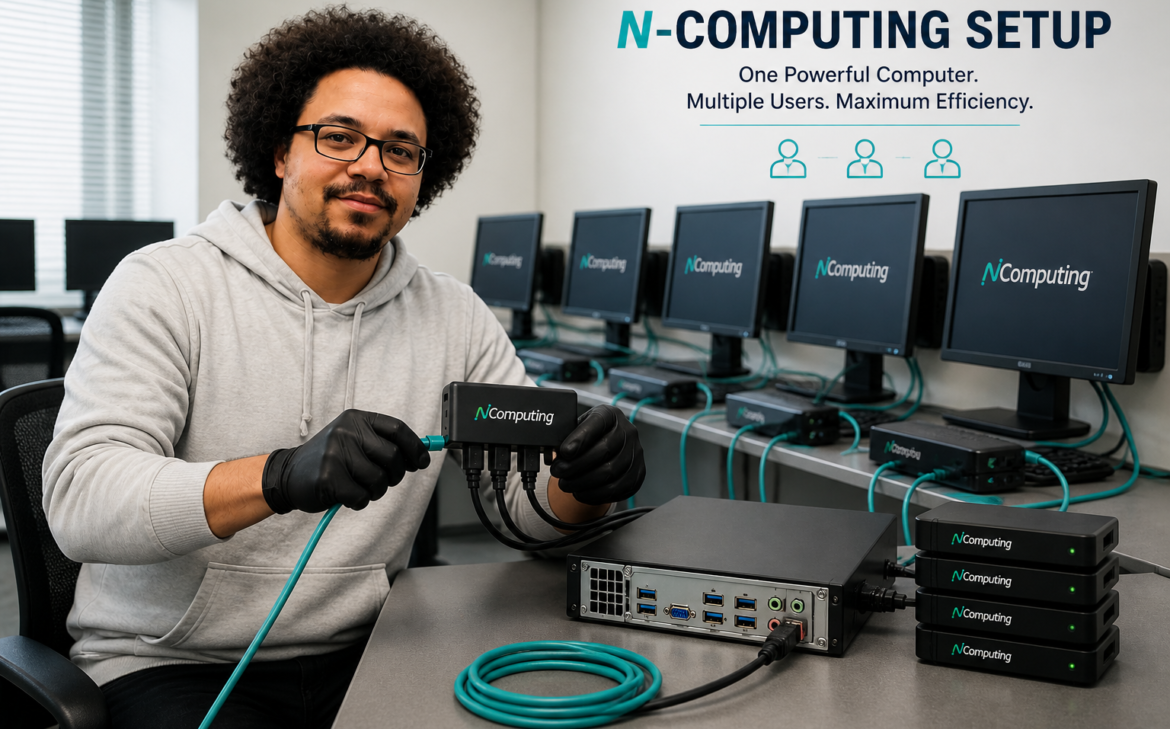
N-Computing is a desktop virtualization technology that allows multiple users to share the processing power of a single host computer simultaneously. Instead of giving each employee a full PC, organizations deploy lightweight endpoint devices — called access devices or thin clients — that connect to a central server or host machine.
The host does all the computing. The endpoint simply handles input and output — keyboard, mouse, and display. Each user gets a fully functional, personalized desktop experience without a dedicated machine driving it.
In practice, a single server running N-Computing software can support dozens of concurrent users, each working independently and seamlessly, as if they had their own personal computer.
It sounds almost too simple. The business case, however, is anything but simple — it is compelling.
1. Dramatic Cost Reduction: The Number That Changes the Conversation
The most immediate and measurable benefit of N-Computing is cost — and the savings operate at every level of the IT budget.
Hardware costs fall sharply. A traditional enterprise PC costs anywhere from $600 to $1,500 or more per unit. An N-Computing access device costs a fraction of that — often under $150. When you multiply that delta across hundreds or thousands of endpoints, the capital expenditure reduction is transformative.
Power consumption drops by as much as 70–90% per endpoint. Thin clients consume between 5 and 15 watts, compared to 65–300 watts for a traditional desktop. For large organizations, this translates into tens of thousands of dollars in annual energy savings — and meaningful progress toward sustainability targets.
Maintenance and support costs decrease because there is far less hardware to manage. Fewer moving parts, fewer failure points, and a centralized architecture mean IT teams spend less time troubleshooting individual machines and more time on strategic work.
Replacement cycles lengthen. Thin client access devices have no hard drives, no fans, and minimal components — they simply last longer and require replacement far less frequently than traditional PCs.
For enterprise finance and procurement teams evaluating total cost of ownership, N-Computing almost always wins.
2. Centralized Management: IT Efficiency at Scale
Anyone who has managed a large fleet of traditional desktops understands the operational overhead involved. Deploying software updates, applying security patches, managing user profiles, replacing failed hardware, reconfiguring machines for new employees — it is relentless, distributed, and expensive.
N-Computing collapses this complexity.
Because all computing happens on centralized servers, IT administrators manage software, updates, configurations, and security policies from a single point. A patch deployed to the server reaches every user simultaneously. A new application installed once is available to the entire workforce instantly. A user’s profile follows them to any endpoint they log into — there is no machine-specific configuration to manage.
This centralization has profound implications for IT headcount and productivity. Organizations running N-Computing environments consistently report that a smaller IT team can support a significantly larger user base than would be possible with traditional desktop infrastructure. The ratio shifts from the typical industry benchmark of one IT staff member per 50–100 PCs to one staff member managing several hundred or even thousands of endpoints.
For enterprises scaling rapidly — through organic growth, acquisition, or geographic expansion — this scalability is invaluable.
3. Enhanced Security: Protecting Data at the Source
In traditional desktop environments, data lives on individual machines. Laptops get lost. Hard drives get stolen. Employees inadvertently store sensitive files locally. USBs walk out of the building. Each endpoint is a potential breach surface.
N-Computing fundamentally changes the security model.
Because thin clients perform no local processing and store no data, there is nothing of value on the endpoint itself. All data remains on the centralized server, protected by enterprise-grade security controls. If a thin client is stolen or damaged, no data is compromised. If an employee leaves the organization, their access is revoked from the server — immediately and completely.
Administrators can enforce strict policies centrally: disable USB ports, restrict printing, control application access, and monitor user activity — all from a single management console. Data loss prevention becomes architecturally simpler when data never leaves the server.
For industries handling sensitive information — finance, healthcare, legal, government — this data-centric security model is not just attractive, it is often a compliance requirement. N-Computing’s architecture aligns naturally with frameworks that mandate control over where data resides and who can access it.
4. Business Continuity and Disaster Recovery
Traditional desktop infrastructure creates fragmented, distributed risk. When a user’s machine fails, that user is offline until hardware is replaced or repaired — a process that can take hours or days. When a building becomes inaccessible, every machine in that building becomes inaccessible too.
N-Computing changes the continuity equation.
Because user environments live on central servers, any employee can log in from any access device and pick up exactly where they left off. A failed endpoint is replaced in minutes — plug in a new thin client, log in, and work resumes. There is no data to recover, no applications to reinstall, no configuration to rebuild.
For disaster recovery planning, centralized server infrastructure is significantly easier to protect, replicate, and restore than a distributed fleet of individual machines. Organizations running N-Computing environments can design high-availability server architectures that keep the workforce operational even during major disruptions.
In a business continuity context, the shift from distributed to centralized computing is not just an IT preference — it is a strategic risk reduction.
5. Sustainability and Environmental Responsibility
Enterprise sustainability commitments are increasingly moving from aspiration to obligation. Regulatory requirements, investor expectations, and customer values are all driving organizations to measure and reduce their environmental footprint.
IT infrastructure is a meaningful contributor to enterprise carbon emissions. Data centers, server rooms, and the energy consumption of thousands of desktop machines add up. N-Computing addresses this directly.
Thin client access devices consume a fraction of the energy of traditional PCs. They generate less heat, requiring less cooling infrastructure. They last longer, generating less electronic waste. And because computing is centralized, server resources can be optimized and shared rather than duplicated across hundreds of individual machines.
Organizations that have transitioned to N-Computing environments routinely report significant reductions in IT-related energy consumption — reductions that contribute directly to carbon footprint targets and sustainability reporting metrics.
For enterprises making ESG commitments, the environmental case for N-Computing is genuinely compelling.
6. Flexibility for the Modern Workforce
The nature of enterprise work has changed. Hotdesking, flexible seating, shift-based work, and hybrid arrangements mean that the relationship between a specific employee and a specific machine is increasingly irrelevant.
N-Computing is architecturally suited to this reality.
Because user profiles and applications live on the server, employees can sit at any access device in any location and immediately access their full work environment. There is no machine to find, no login to configure, no “this isn’t my computer” friction. The workspace follows the person, not the hardware.
For organizations running multiple shifts — manufacturing, logistics, healthcare, contact centers — this means a single set of endpoints can serve two or three times as many users across different shifts without any additional hardware investment.
For facilities teams reimagining office space around flexible and activity-based working, N-Computing enables a far more efficient endpoint-to-employee ratio than traditional desktop deployments.
7. Rapid Deployment and Onboarding
Every day a new employee spends waiting for their workstation to be provisioned is a day of lost productivity. Traditional desktop deployment — ordering hardware, configuring machines, installing applications, setting up user accounts — can take days or weeks, particularly in organizations with complex IT environments.
With N-Computing, provisioning a new user is a software operation, not a hardware one. Create the user account, assign permissions and applications on the server, and point the employee to any available access device. The entire process can take minutes.
For organizations experiencing rapid growth, frequent contractor or temporary staff engagements, or high workforce turnover, this speed of deployment has direct and measurable productivity value.
8. Sector Applications: Where N-Computing Delivers the Most
While N-Computing benefits virtually any enterprise, certain sectors see outsized value:
Education institutions — Universities and schools can deploy lab environments at a fraction of the cost, with centralized management that dramatically reduces IT burden.
Healthcare — Hospitals and clinics benefit from thin clients that can be easily cleaned and sanitized, centralized patient data security, and rapid workstation replacement in clinical settings.
Financial services — Branch networks, trading floors, and back-office operations gain from centralized data control and consistent, auditable desktop environments.
Government and public sector — Budget-constrained agencies can extend hardware lifecycles and reduce infrastructure costs while maintaining security compliance.
Manufacturing and logistics — Shift-based operations benefit from shared endpoints and centralized management of a geographically distributed workforce.
Implementing N-Computing: What to Get Right
The technology is proven. The business case is strong. But successful N-Computing deployment requires planning:
Infrastructure assessment. Server capacity must be sized correctly to support the intended user load without performance degradation. Underspecified servers are the most common cause of poor user experience in virtualized environments.
Network reliability. N-Computing performance depends on network quality. Wired connections are preferable for latency-sensitive applications. Network design should account for peak concurrent usage.
Application compatibility. Most standard enterprise applications run without modification. Highly graphical or resource-intensive applications — video editing, CAD, complex data visualization — may require specific configuration or alternative solutions.
User transition management. Employees accustomed to traditional PCs may need orientation. Change management, clear communication, and hands-on training reduce friction during transition.
Phased rollout. Piloting N-Computing in a single department or location before enterprise-wide deployment allows organizations to validate the architecture, surface issues, and build internal confidence before full commitment.
The Strategic Imperative
N-Computing is not a niche solution for budget-constrained organizations. It is a mature, proven technology that some of the world’s largest enterprises, most demanding public institutions, and most security-conscious industries have adopted at scale.
The organizations deploying it are not doing so out of necessity. They are doing so because the economics, the security posture, the operational efficiency, and the sustainability profile are simply better than the alternative.
The question for enterprise IT and finance leaders is not whether N-Computing works. The question is why, given everything it offers, so many organizations are still provisioning individual machines by default.
Sometimes the most transformative infrastructure decision is the one that makes you wonder why you waited so long to make it.
Considering a transition to thin client or virtualized desktop infrastructure? Start with a cost and utilization audit of your current endpoint fleet. The data will make the case before you even run the numbers on N-Computing.

Leave feedback about this